Damp in a Brussels house: rising damp, condensation or rain penetration?
Three causes of damp with very similar symptoms: what the technical sources say about telling them apart before you have anything treated.
This guide is an adaptation of the French guide. The official sources in French and Dutch, cited at the end of the page, take precedence. Read the guide in French
In this guide
A stain at the foot of a wall, paint that bubbles, black spots in the corner of a bedroom: in an old house these signs look very much alike, yet their causes have nothing in common. The Belgian technical sources agree on one thing: you do not treat damp until you have understood where the water is coming from. This guide brings together the criteria published by Buildwise (formerly the Belgian Building Research Institute, BBRI; CSTC in French), Énergie+ and Bruxelles Environnement (environment.brussels) for telling apart the three main groups of causes, and explains when a professional diagnosis becomes necessary. Wording in quotation marks that reproduces these French-language sources is our translation from the French; titles of pages and documents, and a few technical terms, are left in French.
Key points. The same symptom can have several causes, and there are often several at once (Buildwise). There are three leads to sort out: water rising from the ground (rising damp), moisture in the air settling on cold surfaces (condensation) and rainwater getting in through the facade or the roof (rain penetration). The height of the stain, which way the wall faces, the season and the presence of mould are the first clues. According to Bruxelles Environnement, cleaning off mould is not enough as long as the source of the damp has not been repaired.
One symptom, several causes: the clues that tell them apart
In a set of training materials (slides from a "Bâtiment durable" (sustainable building) course run by Bruxelles Environnement in spring 2019; the slide footers are dated 2016), a speaker from the CSTC, now Buildwise (its renovation laboratory and its technology advisory service on eco-construction and sustainable development in the Brussels Region), sets three goals for a damp diagnosis: identify every cause of damp and the appropriate treatments, anticipate how any work will affect the balance of the building, and avoid work that is unnecessary or even harmful. He warns that the same symptom can stem from different causes and that several causes acting together is very common, which is why an overall approach is needed.
Énergie+ gives the same list of possible origins: rainwater penetration, rising damp (water from the ground climbing up the wall), construction moisture, and leaks from a pipe or a downpipe, plus surface condensation and interstitial condensation. The site points out that the effects you see can result from several causes, which "sometimes even combine and amplify one another".
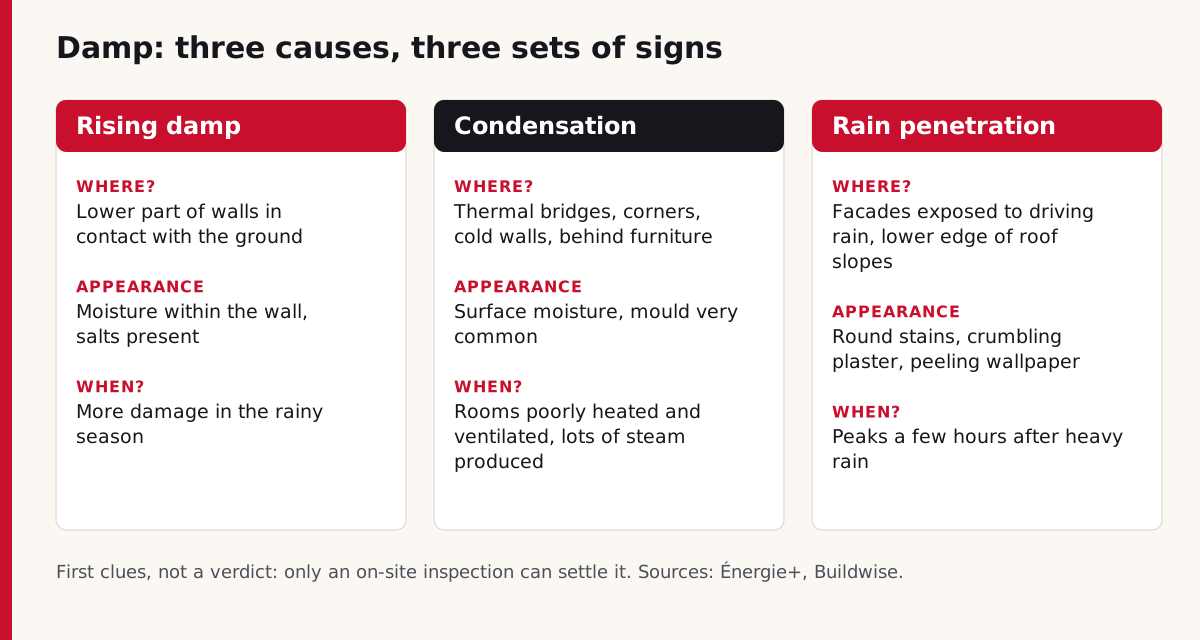
The table below summarises the criteria published by Énergie+ (which draws on a brochure by the Service public de Wallonie, the Walloon regional administration, written with the CSTC) and by the Buildwise presentation mentioned above. They are starting clues, not a verdict: only an on-site inspection can settle the question.
| Rising damp | Condensation | Rain penetration | |
|---|---|---|---|
| Where? | Lower parts of walls in contact with the ground, up to 1.2 to 1.5 m according to Énergie+; a typical height of 0.5 to 1.5 m according to the Buildwise training material (the ranges differ: treat them as an order of magnitude, not a diagnostic threshold) | Thermal bridges (lintels, cornices, corners), cold surfaces, behind furniture; mainly north- or east-facing walls | Facades exposed to driving rain (Buildwise mentions south-west), lower parts of roof slopes, under worn roof coverings |
| What does the damp look like? | Damp throughout the thickness of the wall, varying with height (Buildwise); salts present (Buildwise); damage limited to the lowest storey | Surface damp; stains in corners and in poorly ventilated spots (behind furniture); mould very common | Stains usually roughly round; most of the time too much water for mould to form; interior plaster deteriorating fairly quickly; wallpaper often peeling |
| When? | More damage during the rainy season | Rooms that are poorly heated, poorly ventilated or produce a lot of vapour; winter at 0–10 °C with damp outdoor air | Worst a few hours after heavy rain |
| Other clues | Efflorescence possible at ground level (Énergie+: a "possibility not to be ruled out", not a definite clue) | Interior surface only, non-porous finish | Efflorescence on upper floors; stains on the outside of the facade (also possible with rising damp, according to Énergie+) |
In the "When?" row, Énergie+ also ticks condensation: more damage in the rainy season does not, on its own, tell the causes apart.
Énergie+ mentions two further origins. One is construction moisture, the moisture still present once the works are finished: water absorbed by materials while stored or on site, mixing water, rain during construction. The other is accidental damp, for which the site lists among the clues abnormally high water consumption and visible damage to the roof, the gutters or the pipes.
Rising damp: the wall that drinks water from the ground
According to the Buildwise presentation, a porous material in contact with liquid water absorbs it by capillary action. Without a horizontal damp-proof barrier at the bottom of the walls, any wall in contact with the ground can be affected. The same presentation counts rising damp among the common causes and describes it as very destructive. Énergie+ adds a point that helps with diagnosis: if the lower part of the wall's vertical face is made watertight, the damp can rise higher.
Buildwise publishes a reference technical information note on the subject, NIT 252 (68 pages, 2014), which replaces NIT 210 from 1998. Its first aim is to help detect rising damp and decide whether work is needed; it then reviews the treatment techniques and how effective they can be. The full text requires a Buildwise account; the summary notice is public.
Types of treatment, with no ranking
The Buildwise presentation sorts existing treatments into three groups: those that block the rising water (inserting a physical damp-proof barrier, injecting water-repellent or pore-blocking products), those that cover the masonry (waterproof coatings, renovation plasters known as "enduits d'assainissement") and "others" (treatments that encourage evaporation, electro-osmosis, electromagnetic systems). We do not compare brands or prices: none of the sources we consulted publishes a dated, verifiable price.
For injection, Buildwise gives a rule on height: it is carried out just above the level of the outside ground in contact with the wall; if the outside ground is higher than the inside floor, additional work is needed between the injection level and the inside floor. Among the problems found after an injection treatment, the Buildwise presentation notes that the product itself is rarely to blame. It lists, among others, contaminated plaster that was not stripped off, finishes redone before the wall had dried out, checks made with unsuitable instruments, the presence of hygroscopic salts, and other causes of damp that were not identified at the outset.
What about the cellar?
Buildwise points out that cellars were originally not meant to be lived in: they served as a buffer zone protecting the living rooms. According to the same presentation, turning them into usable rooms often takes a large renovation budget for limited comfort, and things are more difficult where there is water pressure (a water table, or water building up against the masonry). If the water table rises above the cellar floor, it would be very difficult, if not impossible, to treat water ingress permanently in old masonry buildings.
The salts left behind by rising water have a guide of their own: saltpetre on walls.
Condensation: damp air meets a cold surface
Énergie+ describes the mechanism: indoor air that touches a colder surface cools down, and if it drops below its dew point, the vapour settles on the surface. The site gives an example: with air at 20 °C and 50% relative humidity, condensation appears once the surface falls to 10 °C or below. In a building it appears first on glazing, metal window frames without a thermal break, cold water pipes and the cold parts of the building envelope; when it is confined to one precise spot, it gives away a thermal bridge.
On mould, the same site states that it can grow from 80% relative humidity at the surface if the material is hygroscopic, whereas surface condensation requires 100% (Énergie+ says this on its page on spotting condensation problems). For the conditions mould needs, its page "Formation de moisissures" (mould formation) reproduces a text presented as an extract from the CSTC's NIT 153 (we have not read the original note): mould needs enough moisture, a "nutrient base" (dust, adhesives, some paints) and temperatures that in a home are almost always favourable, with the optimum temperature given as between 5 and 25 °C.
What lowers the risk, according to Énergie+
The site sets out four levers: insulate the walls (the inside surface temperature should not fall below 17.5 °C, it specifies), heat, ventilate to reduce the moisture in the air, and limit vapour production (an aquarium without a lid, a combustion appliance with no flue to the outside, a humidifier used heavily). It adds that external causes of damp (rain penetration, rising damp, construction moisture, leaks) must be eliminated before any other measures against condensation or mould are considered.
For indoor humidity, two Bruxelles Environnement pages give separate guidance. On the page "Évitez la pollution dans votre intérieur" (avoid pollution in your home), the ideal humidity level is between 40 and 60% in "dry" rooms and up to 70% in the kitchen and bathroom. In the article "Dangers de la moisissure : 5 bonnes pratiques pour les éviter" (the dangers of mould: five good practices to avoid it) on its citizens' blog, the agency advises airing twice a day for about fifteen minutes with the windows wide open, but for no more than a quarter of an hour in winter or in damp weather, so as not to chill the walls.
Beware of works that just move the problem
Énergie+ points out that better-insulating glazing can shift condensation to other surfaces (window frames, the reveals around openings, corners where the wall meets the ceiling) when the balance of the room is altered. Buildwise, for its part, notes that increasing ventilation can be a preventive measure when a building is made more airtight (insulated roof, new windows). Replacing windows is covered in the guide windows in an old house.
Condensation can also form inside a wall. Énergie+ explains that it is then not directly visible and creates permanently wet zones, with a loss of insulating value and possible damage. In its page on insulating a wall from the inside, Énergie+ requires the system to be perfectly airtight, because moist air getting behind the insulation would condense there.
Rain penetration: when the water comes from outside
According to Énergie+, rainwater is drawn by capillary action into the pores of the material or gets in through cracks and open joints. Buildwise specifies that the walls affected are mainly those facing south-west, solid walls or walls in poor condition, with deteriorated joints.
In its article on diagnosing damp in old houses, Buildwise asks you to check that the cavity, the gutters and the downpipes drain properly, and to check the condition, shape and material of the window sills, the cornices and the coping stones. A poorly maintained downpipe is given there as an example of a cause of water ingress. For the roof covering itself, see the guide roofs in Uccle (Ukkel in Dutch).
On the facade, the Buildwise presentation lists the possible treatments against driving rain: repairing the masonry (repointing), a water-repellent, breathable render or paint, a clear water repellent, and cladding. Only cladding is presented as a complete remedy; the other three bring only an improvement. One warning is spelled out in full: avoid applying water repellent to only part of a facade.
Carrying out the diagnosis: Buildwise's three-phase method
The Buildwise article (CSTC-Contact 2021/6) describes a diagnosis in three phases: visual observation, gathering information and, where needed, measurements. The questions it asks are ones you can ask yourself before calling anyone in.
- Where is the damp? Which way the wall faces, outside walls only or inside walls too, top or bottom of the wall.
- When? Are the stains visible all year round, or only in summer? In the latter case, according to the article, it is "very probably" contamination by hygroscopic salts.
- Since when, and after what? A change in the building's airtightness without matching changes to ventilation can lead to condensation problems; invisible works, such as an injection into the walls, may also have been carried out.
- How is the house used? Are all the rooms heated and ventilated, and when?
- Related signs: mould, smells, finishes coming away, white efflorescence, joints pushed out, drops of condensation.
On measurement, the Buildwise presentation distinguishes indicative measurement (resistance or capacitance meters) from quantitative measurement (the carbide method, known in French as "bombe à carbure", or comparative weighing of samples). The Contact article adds that several measurements are often needed to establish how the moisture is distributed across the height and depth of the wall, that taking a material sample makes it possible to identify the salts, and that monitoring a room's air humidity and temperature over long periods, or an infrared camera for thermal bridges, can complete the diagnosis. The article concludes that diagnosing damp is "a complex process".
Mould and health: what the official sources say
We do not give medical advice. Bruxelles Environnement states that inhaling spores can irritate the airways and worsen conditions such as asthma, bronchitis or allergies, with a greater risk for children, older people and people with weakened immune systems. Above all, the agency stresses that the priority is to understand where the damp is coming from: cleaning off mould is not enough as long as the source has not been repaired.
Its pages give two practical pointers. If more than 3 m² of surface is affected, it is better to call in a specialist company. And if your doctor suspects that the indoor air in your home is to blame, they can request free help from the Cellule régionale d'intervention en pollution intérieure (CRIPI, the regional indoor pollution intervention unit), which takes samples in the home. Bruxelles Environnement encourages you to talk to your doctor if you think the air in your home is harmful.
Before insulating or renovating: deal with the damp first
Énergie+ is categorical about internal wall insulation: any damp problem must be dealt with before it is installed, and the wall must be completely dry. Where damp masonry has received a protective treatment, the site advises waiting for it to dry out, from 6 months to several years depending on the type and thickness of the wall, before insulating. This is a general figure: how long it takes in your house depends on your wall.
If the works affect the facade, the roof or the windows, remember to check with your municipality's planning department whether a permit is needed; the guide renovating a house in Uccle explains the process.
Frequently asked questions
How can I tell rising damp from condensation?
The sources point to tendencies: damp throughout the wall and damage limited to the lower part for rising damp; surface damp, corners and mould for condensation. But Énergie+ warns that the causes can combine. If you are still unsure, a three-phase diagnosis with measurements is the approach Buildwise describes.
Is a shop-bought moisture meter enough to reach a conclusion?
According to Buildwise, resistance and capacitance meters give only an indicative reading; quantitative measurement requires the carbide method or comparative weighing. Buildwise also includes checks made with unsuitable instruments (resistance or capacitance meters) among the problems found after an injection treatment.
My stains change with the weather. Is that normal?
The Buildwise article links stains that are visible only in summer to probable contamination by hygroscopic salts, which draw moisture from the air. For salts, see the guide saltpetre on walls.
Mould appeared after the windows were replaced. Why?
Énergie+ explains that better-insulating glazing can shift condensation to other surfaces, and Buildwise points out that a more airtight building may need extra ventilation. An assessment of the whole picture (heating, vapour, ventilation, thermal bridges) is recommended before replacing glazing.
Should I clean off the mould first?
Bruxelles Environnement advises cleaning at the first signs, but insists that the cause must be found and repaired, otherwise the mould is likely to come back quickly. Follow the precautions given on the agency's page, and if more than 3 m² is affected, call in a specialist company.
Who can I ask for advice?
It depends on the problem: a building professional with expertise in damp diagnosis for the walls; your doctor if you think the air in your home is to blame (according to Bruxelles Environnement, they can request help from CRIPI); your municipality's planning department for permits. We do not recommend any company.
On 03-10-2026 our editorial team reread the Buildwise, Énergie+ and Bruxelles Environnement pages and documents cited; standards, technical notes and recommendations change, so check with Buildwise, Bruxelles Environnement and your municipality's planning department before starting any work. NIT 252, whose full text is reserved for Buildwise account holders, has not been read; only its summary notice has.
Sources consulted
- Buildwise (CSTC), CSTC-Contact 2021/6, article « Humidité dans les maisons unifamiliales et les bâtiments anciens : diagnostic » (damp in single-family houses and old buildings: diagnosis) - accessed on 03-10-2026 buildwise.be
- Buildwise, technical question « À quel niveau des murs faut-il injecter le traitement destiné à contrer l'humidité ascensionnelle ? » (at what height in the wall should a rising damp injection be made?) - accessed on 03-10-2026 buildwise.be
- Buildwise, summary notices for NIT 210 and NIT 252 (rising damp) - accessed on 03-10-2026 buildwise.be
- CSTC/Buildwise (S. Dubois), « Humidité (pollution microbiologique) » (damp and microbiological pollution), Bâtiment durable training course run by Bruxelles Environnement, spring 2019 (slide footers: 2016) - accessed on 19-10-2026 environnement.brussels
- Énergie+: « Repérer un problème de condensation superficielle », « Condensation de surface », « Condensation interne par diffusion de vapeur », « Résoudre un problème de condensation », « Formation de moisissures », « Isoler un mur par l'intérieur » - accessed on 03-10-2026 energieplus-lesite.be
- Bruxelles Environnement: « Dangers de la moisissure : 5 bonnes pratiques pour les éviter » (citizens' blog, accessed on 19-10-2026) and « Évitez la pollution dans votre intérieur » (accessed on 03-10-2026) environnement.brussels
Published on , updated on .